After working in this new private school for about 3 weeks, I finally did something I think it's fun and inspiring for the students-- we had our 1st Chinese rhyme contest.
Contestants: 17 7th graders
Level: Beginning
Textbook: Huanyin Volume 1, Part 1
Class hours required: 2 hours & 10 mins (one regular 50-min class, one 80-min long block class hour)
Materials: Youtube video clip on Smartboard, peer review sheet
I chose 5 short rhymes on Huanyin workbook; one of them is the famous "Two Tigers" (liang3zhi1 lao3hu3)
Step 1 Warm Up:
I first let the students watch a video clip on youtube. With its vivid illustration and the famous tune of French "Bruder Jackob", students could understand and sing along with "Liang3 Zhi1 Lao3hu3" after a few times.
Step 2 Practicing:
Read out loud: Go through each rhyme without explaining the meaning too much, since this is just a practice for them to work on pin-yin sounds and 4 tones. I randomly assigned each individual to read out loud for each short phrase first, then correct their pronunciation.
Step 3 Strengthening:
Repeat after me: Then I asked all students to repeat after me for each single rhyme, and I gave them 5 mins choose their favorite one to practice on their own. I also let the students listen to the on-line audio clips for a different accent and speed, so they can get used to different Chinese speakers.
After these steps, most students should have listened to the same rhyme for about 3~10 times (depends on how much they have really listened into their minds...)
Step 4 Preparation time: I gave the student a weekend, and the following Monday to prepare for the contest. They can also listen to the on-line audio clips provided by the publisher at home.
Contest:
On the day of the contest, each student drew a lot (chou1 qian1)to decide the order of their performance. I also give each students 2 peer review sheets (see image), so they can grade each others' works (which the students love a LOT). I suggested them not to abuse their power of being a judge, and encouraged them to give decent & honest comments to their fellow classmates.
During the contest, each student came up to the front of the class, bring (or not) their own rhyme sheet, and chant (or sing) it out loud, starting with a brief self-introduction, ending with a thank you and bow.
The result if fun.
Overall, most students gave away pretty positive comments to other students. For example: "I can tell you have prepared a lot for this..."; "I think you need to practice more on xxx..."; "You seem to lack of confidence...."; "Don't slouch when you're on stage..."; "You forgot to bow...."....many amazing comments.
3 students held the same 3rd place. The students held the 2nd and the 1st place were only 0.2 point away... very intense competition.
Remarks:
I also taped some students' performances with their prior permission. And I played it on Smartboard at the beginning of the next class. Some of them felt as if they were famous now, some felt a bit embarrassed. Very diverse and mixed emotions toward public performance. But, by doing this, they get to see how good they were to speak a foreign language in public, and proved their confidence to be filmed--which, needs a lot of courage for 13-year-old girls.
Tuesday, September 23, 2008
Chinese Rhyme Contest

Monday, September 1, 2008
Different Ads, different psyche
.JPG)
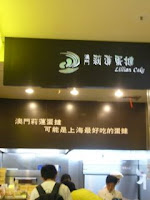
My friend M took a very "modest" Chinese "egg custard" ad in Shanghai this summer, and posted it on her blog. It says: "Macao's Lilian egg custard 'probably' is the best custard in Shanghai".
Monday, August 4, 2008


Thursday, July 31, 2008
Restroom Signs


My currently 8-year-old super-cute niece has been visiting me in the U.S. once a year since the age of 4. I taught her some survival English sentences while she was here (those English lessons they taught in kindergarten NEVER comes handy in real life...).
One important thing to ask is knowing how to go to the bathroom. So, I taught her: "Excuse me, where is the bathroom?"
Then, when you arrive in front of the bathrooms, try to recognize the sings printed on either door (if, unfortunately, they don't have the universal icons on the doors, e.g. pipe/tie for men, skirt/high heels for women). If you see W-O-M-E-N, which means girls, then you can go in. And the way to remember women is easy. The word women starts with a "W", which looks like women's breasts, then "O" look like a pretty face a woman has.
So, there she goes without any problem at all time. Until one day, she returned with an anxious facial expression.
"What's wrong? You couldn't find the bathroom?"
"No", she said, "I found it."
"So, what's the problem?"
" I couldn't find the word you told me on the door. I didn't know which one to go into..."
I followed her to the bathroom. And see only one word on each door, without any icons or graphs.
"Ladies"
"Gentlemen"
I pointed to the right one, and asked her while she was doing her business:
"Ning-zi", I said, " Now you still think you're too busy to take English classes?"
I'm glad to know that her mom has already enrolled her in an English class, starting this September. Hopefully, she'll be more literate when she visits me next year.
Same thing in Chinese. Sure I always taught my students to ask:
"Qing wen, ce suo zai na?" before they traveled to China as one of their survival Chinese sentences, and how to recgonize the words "nan(2) 男”and "nu(3) 女". But, look at the following signs I took on the bathroom doors in Taiwan.
Which one(s) you can't tell right away?
Thursday, May 29, 2008
The Name's Sake
Watched the morning news at KTLA this morning, and found out the most popular names of 2007 (per Social Security Administration):
BOYS:
- Jacob
- Michael
- Ethan
- Joshua
- Daniel
GIRLS:
- Emily
- Isabella
- Emma
- Ava
- Madison
Mmm... Not surprisingly, there are 3 out of the 10 most popular names in my husband's family!
The baby name expert in the show said that if a girl's name is ended in an 'a' sound makes the name sound more powerful. Hence the bella, ma, and va. Also, girls' names tend to be more romantic and old-fashioned these days. Of course the pop culture has another influence on the baby-naming business too.
The interesting thing is, many popular American names in the 70's have fallen out of the top 100 list. Therefore, when we were in high school in the 80's, those cheerleader types of names, such as: Jennifer, Julie, Stephanie or Megan, were not used to name baby girls in the new millennium any more...
This also reminds me my "Critical Thinking" class back in college. That summer in 2003, when I found out there were 7 "Jen, Jenny, and Jennifer" out of 35 students in that Philosophy class (thanks to my last name... it's on the very end of the alphabet chart that gives me the chance to hear everyone's name before the professor called my name), I decided it right away to change my American name back to my Chinese name. Ever since that smart decision, I hardly hear anyone has the same name like mine (though it usually takes a while to let people remember my name if they weren't told a story associated with it...).
So...Guess what my previous American name is? Haha.
Friday, May 16, 2008
Boba or Pearl Tea?
Checked a new lesson on Chinese Pod today regarding "Pearl Tea".
I enjoyed reading all those comments, and mostly agreed with what "elee8888cn" said there that "Pearl Tea was originally invented in Taiwan in 1983 and has became one of the most famous branches of the Bubble Tea. It was later introduced to Chinese and US market by a couple of Taiwanese owned cafes..." .
However, since Pearl Tea was invented by Mr.Liu(2) Han(4)jie(4) 刘汉介 in my hometown, Tai (2) Zhong(1) 台中(the biggest city in central Taiwan), and I had had at least 5 tons of all kinds of pearl tea from mid 80's to 2002 (I moved to the U.S. in 2002), I think I have to add a little bit history to the commonly called "Boba" tea (it refers to the bigger sized bubbles added in the tea).
The original meaning of 波霸 Bo(1) ba(4),is quite a condescending nickname for women who have HUGE breasts.
- The word "波 bo(1)" means "tits" or "boobs" in Cantonese (since it's a nickname from Hong Kong, and Cantonese is the main dialect in Hong Kong area).
- The 2nd word "霸 ba(4)" means huge or gigantic.
- Hence "波霸“ actually means "HUGH BOOBS" in Cantonese (now you know why I said it's a condescending word for females).
Why it's from Hong Kong? Why huge boobs?
In the late 80's, there was a very famous actress in Hong Kong named "葉子媚 ye(4) zi(3) mei(4)", who was famous mostly because of her 36F cup sized breasts. As you may know, for most Asian women, they tend to have flatter breasts. So, when this Hongkong-nese "Pamela Anderson" type of actress showed up in media, people soon gave her a nickname "波霸“ to compliment on her breasts (sure, there were also all kinds of rumors said that she'd done some plastic surgery to make them that big, but, hey, it was last 80's... and we're not going to discuss this here).
Anyway, after the "Pearl Tea" was so popular in Taiwan for a few years, people seemed to get tired of it. Therefore, one bartender at a tea house in 台南 tai(2) nan(2) (a big city in southern Taiwan) was "inspired" by that actress' popularity, and made some special orders of multi-layered "pearl", "bubble","tapioca" (which-ever you'd like to call it), and sold it with the also super-sized straw (so you can suck the bubbles up smoothly), tried to make this special tea drink a new life.
BOOM! Big success!
Then the name "Boba" tea spreaded around the world; people enjoy drinking it without knowing it's actually named after an actress with speical talents.
More info on this actress (or if you want to see what she look like), check this link on Wiki:http://en.wikipedia.org/wiki/Amy_Yip
I personally prefer "Pearl Tea 珍珠奶茶“ though. It is just more elegantly original. I'm so proud of Pearl Tea. Not only it's invented in my hometown, but it has become one of my best dishes when it comes to party time!
Thursday, May 15, 2008
Radicals 部首 bu(4)shou(3)
When I was teaching ESL, I discovered a very common and fundamental problem among many ESL learners--spelling & pronunciations;many ESL learners don't have the concept of "phonics" and "spelling rules" in American English. Either no teachers had ever taught them these concepts, or the teachers tried to (and had to) finish all 45 "K.K. spelling symbols" within one week right after the English beginners just being taught 26 alphabets (or phonics).
The result? Big confusion! The ESL learners would never get to spell a word properly when they hear it, or pronounce a word when they see it.
How about in Mandarin Chinese learning? "Pin-Yin" spelling rules and the concept of "radicals" are the basic tools for any CFL (Chinese as a Foreign Language)learners to acquire Chinese characters.
However, when my cousin T asked me to tutor her for her advanced Chinese homework in college the other day, I was surprised to learn that she doesn't have some basic concepts of radicals even after learning Mandarin for 3 years (and she just returned from China after being an exchanged student there for 1 year, not mention using the radicals to look up a word in the dictionary). Cousin T was totally surprised to know that there are actually some easy and fun ways to remember characters!
Anyways, if you're going to teach or learn Mandarin, I highly recommend you to teach/learn the 214 radicals (yeah, I know it sounds a lot... but it definitely helps! Learn at least 50 of them) right from the beginning. What I like to do is, when I start teaching the initials (consonants in English) of Pin-Yin, I'll use the radicals as the example words for these sounds (or you can use words that are going to show up in the first 3 lessons as examples):
- t: 土 tu(3) earth, soil, ground, dirt.
土tu(3) is the radical for "在" (preposition: in, on, at) ,"地"(ground), "坐"(to sit) that students are going to learn soon in the beginning level.
- r: 人ren(2) a person.
人ren(2) is the radical for "你"(you),"他"(male he/him/his),"休" (to rest), which all contains some "human" actions.
- k: 口 kou(3) mouth, opening, sounding
口(3) is the radical for “呢”"吗“(both question markers), "吃”(eat)
Or you can simply google "Chinese radicals", you can find all the info you need.
One interesting thing happened in my tutoring class yesterday. When my student P was learning a new word "消炎药" in the "Going to a Doctor" lesson, after he saw the pin-yin, he first pronounced the word correctly, then I asked him not to peek at the English meaning, tried to make a wild guess first.
He located the first character with a vertial "water" radical on the left, the 2nd character with 2 "fire" radicals, then the 3rd character has a "herbal, grass,plant" radical on the top... So, he guessed this must be some kind of "antibiotics", because it looks like some sort of "herbs" you can use as the "water" to put out 2 big "fire" in your body?
Bingo!
The beauty of radicals...
It might seem hideously slow at the beginning when you try to incorporate radicals into teaching each word (sure I'll skip some tricky words without even mention their radicals in the beginning level). Well, just like any English speakers who want to achieve a higher level of proficiency or enter the "spelling bee" contests, you have to take Latin lessons to learn all those prefix, suffix and etymology; so does in learning Chinese.
Friday, May 9, 2008
Cure for Eczema?
One of my tutoring student D is visiting her sister in Taiwan these days (her sister is currently learning Mandarin in Taipei). Got an e-mail from her today asking me if I can tell her where my Chinese doctor's clinic is because her sister is suffering from very bad eczema and allergies.
As a veteran of having eczema and all kinds of allergies forEVER and had lived in Taiwan for over 30 years, I gave some suggestions for her sister:
- Find a TCM (traditional Chinese medical) doctor that is close or convenient to her (or covered by her student's insurance), so she can pay frequent visits whenever the symptoms get worse.
If you go to the western dermatologist, you will get the ointment, take some drugs to suppress the symptoms (or give you a shot of cortisone if the symptoms are really bad). Then you can only prey for a delay of the next burst sometime again. However, in TCM theory, eczema or many kinds of allergies are the results of the dampness in the spleen, ill digestion in the stomach, excessive heat in the liver and hence the depletion of liver energy.
Therefore, to possibly "cure" eczema (There's no way to cure eczema with today's medical technology. You can ask for living with eczema peacefully, and it only comes visiting your from time to time), the TCM use the herbs, acupressure and acupuncture, or moxibustion to enhance the funtions and circulations in certain organs, and therefore remove the stagnation/dampness/excessive heat of relative areas, and more effectively relieve your symptoms.
If we use "an overheated kitchen stove on a very damp tile floor" to be the analogy of eczema, let's compare how the western and Chinese way of dealing with the issues in the kitchen (our body).
- Western dermatologist: first of all, the doctor might splash some cold water or throw some ice(drugs or shots) on the stove to cool down the hot kitchen (so the kitchen will be cooled down right away). Then the doctor lay some paper towels on the damp floor (the ointment), so the cook (our skin) won't fall on the slippery floor. Then, the cook can still perform what he/she supposes to do in a short term.
And when the kitchen is soon over-heated again, the doctor might tell the cook to turn on a fan or air-conditioning(depends on how rich you are) to control the possible up-coming hazard...
- TMC doctor: first the doctor try to locate the origin of the hazard. If it's the broken knob on the switch, turn the switch down a bit to low fire, so the surface and back splash behind the stove (the breakouts and rashes in our skin) will gradually cool down. Then the doctor tries to find some rag to slowly absorb the dampness on the floor, so no one will fall on it again. However, the whole process will take a while (depends on how damp and over-heated this kitchen is).
I'll write more about other "cures" some other time. Go to run some errands now.
Thursday, May 8, 2008
The importance of REVIEW
Like we'll check the pantry and fridge before we do grocery shopping, or you check your wardrobe before you do your seasonal shopping (being a must-be-organized person, I do that all the time), it is important to take a break, pause, and review whatever you've learned from time to time when it comes to learning Chinese characters.
After I told my tutoring students that I'll be no longer tutoring them from next month, they accepted it pretty well (sure, they're adults!) and asked me to keep in touch with them. Student D is going to travel in Taiwan and China, and she promised me to submit the "special assignment" I gave her after her return. Student P is going to travel to France and Japan, so it's a actually a good timing for him to stop the lessons for a while. So, I feel less guilty to "abandon" them, according to P.
Anyway, for both of them, I gave them a big assignment: re-organize all the vocabulary they've learned so far, and compile a chart of them. I ask D, who has just learned Mandarin for about 36 hours (over the during of 6 months), to turn in a list of at least 50 vocabulary. For P, he's more on the edge of a beginner and intermediate level now, so I asked him to give me a list of at least 500 vocabulary.
By listing the words by a few different categories: Subject, Verbs, Nouns, then Adjectives, Adverbs, Phrases... The students (even for the teacher) get to know what they've remembered in their brains, and what they have given back to the teacher. And then they can focus on what they've been missing, and strengthening the grammar concepts by putting the words in the right order to create their own sentences.
Tuesday, May 6, 2008
Mocha V.S. Latte
Interesting clip on Tudou.com (equivalent to youtube.com in the U.S.).
Even though you don't know Chinese very well, it's fun to watch that cute little cat trying to fight the dog, and get some place of its own...
Saturday, May 3, 2008
Textbooks
I sent out a WISH LIST to my supervisor after talking to her last Wednesday:
Chinese Textbooks for 08-09
- Intro of Chinese -- 6th Grade
Ni Hao : Revised Simplified Edition, Volume 1 - With CD
Author: Shumang / Fredlein, Paul
Publisher: Cheng & Tsui Co. - Chinese A--7th Grade
Huanying, Volume 1 –Full year Textbook (paperback) + free audio downloads
Author: Jiaying Howard, Lanting Xu
Publisher: Cheng & Tsui Co. $59.95
Workbook: Huanying, Volume 1, Part 1 $19.95 - Chinese 1 -- 9th & 11th Grade
Huanying, Volume 1 -part 1+2, Textbook (paperback) + free audio downloads
Author: Jiaying Howard, Lanting Xu
Publisher: Cheng & Tsui Co. $59.95
Huanying, Volume 1, Part 1 –Workbook $19.95
I also requested the ordering of 2 Teacher’s Books, price TBA.
By the way, I recommended the students to do some light reading as a supplementary material:
Title: China: Empire of Living Symbols (Paperback)
Author: Cecilia Lindqvist
Edition: 08
Publisher: Da Capo Press (May 5, 2008)
Price: $25.00
You can easily get the paperback copy form amazon.com now. I just got my paperback copy 3 days ago (the hardcover one is like $100, very expensive), and love it!! The chair said we probably can get a few, and put it in our library for students' reference.
Thursday, April 24, 2008
Teaching Chinese as a Foreign Language

One of my tutoring students e-mailed me this new book info that will be published by Cheng & Tsui this June. I guess there will be more and more books like this for teachers to be published in the future.
Thursday, April 10, 2008
Chinese Bilingual Teacher Education Program at LMU
M was just asking me if there is any graduate program that provides not only a master degree, but also a CA teaching credential. That reminded me there IS a program like that promoted by a professor from that university when I attended the IC workshop last month.
This is a private university in Marina Del Rey-- Loyola Marymount University. According to the program coordinator, Terry Qian (who I briefly talked to after the workshop that day), after some school board members visited China earlier this year, they decided to launch their new Chinese Bilingual Teacher Education Program this summer.
The tuition is super expensive, $830 per unit. You need to finish at least 36 units (9 classes) to graduate. So the total expense for attending this program will be approximately $30,000 (not including textbooks, living or commuting expense).
Even though LMU (Loyola Marymount U) claimed to offer "StarTalk" scholarship to all accepted applicants, which ONLY covers half of the tuition for 2 summer prerequisite courses and full amount of test fees... which are valued at about $1,300. So... not really helpful.
That's the reason why I didn't even consider applying for the program. Private school is untouchable...
Friday, April 4, 2008
Master Chinese in 3 months?
LA18 news reported that a 24-year-old Chinese American man tried to create a record of mastering Chinese in 3 months. This young man's name is Jason Gong; his father is Chinese. But he claims that his father had never taught him any Chinese when he was little, and his parents got divorced when he was 9. He also showed the reporters some proofs at the press conference yesterday that he has no level of Chinese at all-- a total beginner. His goal is to be able to read Chinese newspapers 3 months later.
He refused to reveal what his methodology would be in achieving this seemingly impossible mission. He said, he's afraid that people might copy his methods, and break his record before he can make it. But, he would be willing to tell the world 3 months later when he makes it.
Jason Gong also applied for Guinness world records. Let's wait and see...
Monday, March 24, 2008
John Adams
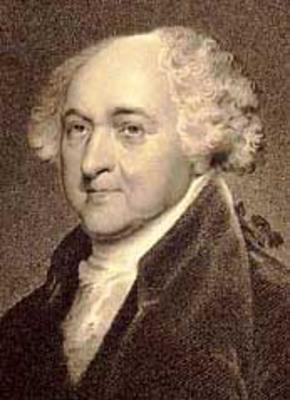

I've been interested in history in all times.
Not until last week had I had the interview at a private school, the Lang. dept. Chair told me to be prepared that the school might want the Chinese teacher to teach one Chinese History class outside the regular language classes (IF, there aren't enough enrollment...). I remembered I used to think that if I didn't teach the language subject, I'd like to teach history instead.
History, i.e. his+story, apparently it's a genre about all kinds stories. Who wouldn't love stories? That's also the reason why I like watching movies, I guess, to see how the director tell a story.
Anyways, after Elizabeth I and II, almost all Jane Austen's adopted movies & TV series, I really enjoy watching HBO's John Adams for the past 2 weeks. It was only 5 years ago that I took the American History class during my 1st semester at SFSU. I could never remember the original 13 states at that time. However, after the 1st 2 episodes on HBO, those 13 states are easier to memorize now.
One interesting thing I observed in "John Adams" and it's also related to my profession is, when Johan Adams was assigned to gain the $$ and alliance with France in 1776, even as such a eloquent lawyer like John Adams himself failed to accomplish his mission due to the cultural difference and language barrier (Yeah... when the French king Louis XVI made fun of him:" No French? Not even one word?!" That really humiliated Adams).
Thank goodness, Adams' very political accurate wife Abigail asked him to bring their eldest son, John Quincy Adams (later he was elected as the 6th U.S. president in 1825 ), with him during this long trip. Little John Quincy went to school in Paris probably from ages 10~14, then at the age of 14, he travelled to St. Petersburg, Russia under his father's will to serve as translator and interpreter to the newly appointed American minster because the new U.S. diplomat needs a secretary who speaks French to help him survive in Queen Catherine's French-speaking court.
When I was watching this segment of the episode, I couldn't help but wondering what Mindy said in the comment about why most American are monolingual... So, we might see what things were like 230 years ago in the colonial America era. Sure, we can always debate that there might not be any resources for ordinary people to acquire a foreign language when they were struggling from day-to-day life. But, what about now?
Being able to speak French might not be the sole reason that John Quincy Adams later became the 6th U.S. president, but it was definitely the main reason why he was chosen to be the secretary at the age of 14. I believe that knowing a foreign language won't necessary bring you any immediate benefit, but surely will broaden your horizon of the world. And when the opportunity knocks on your door, you'll be more ready than others who don't posses this ability.
Thursday, March 13, 2008
Eating is the most important thing! 吃饭皇帝大
One of my tutoring students sent me this comic strip from Germany (he's on a business trip) today: (I've tried to post the comic here, but didn't work...)
The dialogues between these 2 businessmen are:
- A: I've been very impressed by the Chinese approach to business...
- B: Yes, me too.
- A: I came here expecting to find a country whose traditional ways of doing things would hamper its aspirations to be a 21st century economy...
- B: (listening)
- A: But in fact, many aspects of ancient Chinese culture are fully in tune with modern business requirements...
- B: Yes... Chopsticks in particular.
- A: Quite. One doesn't have to waste valuable Blackberry time whilst one's eating...
Indeed. I find chopsticks super useful for me. I don't really need a fork or a spoon, all I need is a rice bowl and a pair of chopsticks, then you can have almost any kinds of food with them (mm, I even use chopsticks for eating French Toast or salad). You don't need tongs when you're cooking. And you can even use chopsticks as a knife when it comes to eating some tricky food (like steak). Or even better, if you have long hair, you can fix your hair with it, you can fight (or stick) your brothers with them at a dining table... Very useful...
So... I guess that's why ancient Chinese invented chopsticks and keep using them even now -- to force you focus on eating only, not reading or typing at the same time?! Haha (it's healthier for you to concentrate on eating anyway).
Speaking of health, here's some "Chinese way of living" for everyone.
An old Chinese saying: 吃饭皇帝大 (chifan huangdi da)
When one is eating, one is greater than the emperor.
Meaning: When someone is eating, even though he's only a peasant, we should treat him like an emperor and respect his basic human right of satisfying his tummy.
Underlined meaning: Food is the most important thing for commoners (or, for us middle class nowadays). We don't care who the emperor (or president) is, when we're hungry, we want food. If you bother me when I'm eating (or, can't even provide food for us, or can't 'SHOW ME THE 'FOOD'), I don't give a dxxn that even though you're a emperor (or president).
I attached 2 pix for you. One was my niece demonstrated how to use ONE chopstick to eat a cob of corn during the Chinese New Year's Eve dinner. Another was my brother (my niece's Dad) showed you how to stick people with chopsticks (pls do not imitate, it's very dangerous.... haha).


Thursday, March 6, 2008
Why Chinese?
Read this blog entry from another Chinese teacher's blog
http://blog.huayuworld.org/shirleyc/109/2007/12/19/873, found it's interesting to me.
Maybe I've been tutoring very motivated, adult professionals for the past 5 years; I don't have to worry about this question at all. After all, when my students come to me, basically, they are all eager to learn. All I have to do is to show them the effective ways and tools to acquire Chinese language skills, so they can move on to do it on their own.
But, if I'm gonna teach 5th ~12th graders in private school next school year, I guess I have to come up with some very creative and inspiring ideas for those rich, spoiled kids (to quote the bus driver on Big Blue Bus 14, when he referred to the kids who went to private schools) to study Mandarin Chinese.
So, I personally add 3 more reasons to study Chinese outside the "normal" catagories.
(please read No. 1 to 11 from Teacher Shirley's blog entry)
12. So you can order food or talk to the servers at Chinese restaurants "in Chinese" to impress your friends or family!
13. You can understand a lot of "interesting" Chinese character tattoos on many people's body parts, or on many merchandise sold in stores.
14. You'll never know IF someday you are gonna meet a hot Chinese boy/girl, and make friend with him/her.
Haha. Just for fun. Maybe those kids would buy it!
Monday, March 3, 2008
Regional Variety
I think the local TV station--LA 18-- must be run by Taiwanese Chinese.
Few reasons:
1. They use traditional characters in the show and on the website.
2. They anchors have Taiwanese Chinese accent.
3. The translation of many places and terms are also mainly used in Taiwan.
For example:
"Subprime Mortage Crisis"-- the problem which began last summer in Stockton, California and continues to ricochet through the economy and has led the U.S. edges closer towards a recession--has a few different translations along the Pacific Ocean.
- In China, they call it 次贷危机
- In the U.S. or at least on LA 18 TV channel, it's called 次级房贷风暴
- In Taiwan, 次級房屋信貸風波
I personally prefer the translation in the U.S. The word "风暴" feng (1) bao (4), the direct translation will be "storm", if you look up this word in the dictionary. Sure it's different from the original "crisis", but this "crisis" does bring a certain degree of "stormy" effects to people throughtout the U.S. and affect many economies outside of the U.S. So, I wouldn't say it's not perfect to translate "crisis" into "storm" in Chinese.


