Showing posts with label Mandarin Teaching. Show all posts

Monday, September 28, 2009

China's Lost Girls


Intrigued by the cover story on L.A Times 2 weekends ago (see previous blog entry on Sept. 28th), I rented this documentary from Netflix. It's a short documentary (43 mins), so it doesn't delve into a deeper level of the "one-child policy" consequences (or aftermath?!). However, if you're interested to know how the "one-child policy" affect China on its 30th anniversary (yes, the policy started in 1979), or you want to know how it feels like to adopt a baby girl from China, this film satisfy your curiosity.

The film is well-produced by National Geographic. I actually cried a few times while watching this film. I was planning to create a lesson plan (use 2 hours) combining this documentary with the cover story on LA times for my high schoolers after Moon Festival (or after their first test).

Adopt a baby girl from China?


I knew there's something unusual going on when I saw that many Chinese-looking baby girls in Disneyland for the past 3 years...This is a long article. Prepare for 10-15 mins to finish it.Or, not finish it.

The cover story on last Sunday's L.A. Times:
http://www.latimes.com/news/nationworld/world/la-fg-china-adopt20-2009sep20,0,491086.story


Tuesday, September 23, 2008

Chinese Rhyme Contest

After working in this new private school for about 3 weeks, I finally did something I think it's fun and inspiring for the students-- we had our 1st Chinese rhyme contest.

Contestants: 17 7th graders
Level: Beginning
Textbook: Huanyin Volume 1, Part 1
Class hours required: 2 hours & 10 mins (one regular 50-min class, one 80-min long block class hour)
Materials: Youtube video clip on Smartboard, peer review sheet


I chose 5 short rhymes on Huanyin workbook; one of them is the famous "Two Tigers" (liang3zhi1 lao3hu3)

Step 1 Warm Up:
I first let the students watch a video clip on youtube. With its vivid illustration and the famous tune of French "Bruder Jackob", students could understand and sing along with "Liang3 Zhi1 Lao3hu3" after a few times.

Step 2 Practicing:
Read out loud: Go through each rhyme without explaining the meaning too much, since this is just a practice for them to work on pin-yin sounds and 4 tones. I randomly assigned each individual to read out loud for each short phrase first, then correct their pronunciation.

Step 3 Strengthening:
Repeat after me: Then I asked all students to repeat after me for each single rhyme, and I gave them 5 mins choose their favorite one to practice on their own. I also let the students listen to the on-line audio clips for a different accent and speed, so they can get used to different Chinese speakers.

After these steps, most students should have listened to the same rhyme for about 3~10 times (depends on how much they have really listened into their minds...)


Step 4 Preparation time: I gave the student a weekend, and the following Monday to prepare for the contest. They can also listen to the on-line audio clips provided by the publisher at home.

Contest:
On the day of the contest, each student drew a lot (chou1 qian1)to decide the order of their performance. I also give each students 2 peer review sheets (see image), so they can grade each others' works (which the students love a LOT). I suggested them not to abuse their power of being a judge, and encouraged them to give decent & honest comments to their fellow classmates.

During the contest, each student came up to the front of the class, bring (or not) their own rhyme sheet, and chant (or sing) it out loud, starting with a brief self-introduction, ending with a thank you and bow.

The result if fun.
Overall, most students gave away pretty positive comments to other students. For example: "I can tell you have prepared a lot for this..."; "I think you need to practice more on xxx..."; "You seem to lack of confidence...."; "Don't slouch when you're on stage..."; "You forgot to bow...."....many amazing comments.

3 students held the same 3rd place. The students held the 2nd and the 1st place were only 0.2 point away... very intense competition.

Remarks:
I also taped some students' performances with their prior permission. And I played it on Smartboard at the beginning of the next class. Some of them felt as if they were famous now, some felt a bit embarrassed. Very diverse and mixed emotions toward public performance. But, by doing this, they get to see how good they were to speak a foreign language in public, and proved their confidence to be filmed--which, needs a lot of courage for 13-year-old girls.

Monday, September 1, 2008

Different Ads, different psyche


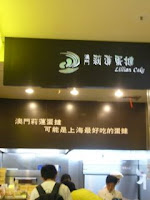
My friend M took a very "modest" Chinese "egg custard" ad in Shanghai this summer, and posted it on her blog. It says: "Macao's Lilian egg custard 'probably' is the best custard in Shanghai".


Weeks later, I found another not-too-modest ad printed on a menu of a restaurant in Santa Monica, which responds to the Chinese ad very well. The American ad says: "Omelette Parlor 'probably' (which is crossed out) the best omelettes in the west".
Just an interesting find.

Monday, August 4, 2008

Restroom Signs part II


More signs I took in June, 08, Taiwan.

Thursday, July 31, 2008

Restroom Signs


I have been travelling a lot for the past 2 months... finally got some time to update my blog!

My currently 8-year-old super-cute niece has been visiting me in the U.S. once a year since the age of 4. I taught her some survival English sentences while she was here (those English lessons they taught in kindergarten NEVER comes handy in real life...).

One important thing to ask is knowing how to go to the bathroom. So, I taught her: "Excuse me, where is the bathroom?"

Then, when you arrive in front of the bathrooms, try to recognize the sings printed on either door (if, unfortunately, they don't have the universal icons on the doors, e.g. pipe/tie for men, skirt/high heels for women). If you see W-O-M-E-N, which means girls, then you can go in. And the way to remember women is easy. The word women starts with a "W", which looks like women's breasts, then "O" look like a pretty face a woman has.

So, there she goes without any problem at all time. Until one day, she returned with an anxious facial expression.

"What's wrong? You couldn't find the bathroom?"
"No", she said, "I found it."
"So, what's the problem?"
" I couldn't find the word you told me on the door. I didn't know which one to go into..."

I followed her to the bathroom. And see only one word on each door, without any icons or graphs.

"Ladies"
"Gentlemen"

I pointed to the right one, and asked her while she was doing her business:
"Ning-zi", I said, " Now you still think you're too busy to take English classes?"

I'm glad to know that her mom has already enrolled her in an English class, starting this September. Hopefully, she'll be more literate when she visits me next year.

Same thing in Chinese. Sure I always taught my students to ask:
"Qing wen, ce suo zai na?" before they traveled to China as one of their survival Chinese sentences, and how to recgonize the words "nan(2) 男”and "nu(3) 女". But, look at the following signs I took on the bathroom doors in Taiwan.

Which one(s) you can't tell right away?


Friday, May 16, 2008

Boba or Pearl Tea?

Checked a new lesson on Chinese Pod today regarding "Pearl Tea".

I enjoyed reading all those comments, and mostly agreed with what "elee8888cn" said there that "Pearl Tea was originally invented in Taiwan in 1983 and has became one of the most famous branches of the Bubble Tea. It was later introduced to Chinese and US market by a couple of Taiwanese owned cafes..." .

However, since Pearl Tea was invented by Mr.Liu(2) Han(4)jie(4) 刘汉介 in my hometown, Tai (2) Zhong(1) 台中(the biggest city in central Taiwan), and I had had at least 5 tons of all kinds of pearl tea from mid 80's to 2002 (I moved to the U.S. in 2002), I think I have to add a little bit history to the commonly called "Boba" tea (it refers to the bigger sized bubbles added in the tea).

The original meaning of 波霸 Bo(1) ba(4),is quite a condescending nickname for women who have HUGE breasts.

  • The word "波 bo(1)" means "tits" or "boobs" in Cantonese (since it's a nickname from Hong Kong, and Cantonese is the main dialect in Hong Kong area).
  • The 2nd word "霸 ba(4)" means huge or gigantic.
  • Hence "波霸“ actually means "HUGH BOOBS" in Cantonese (now you know why I said it's a condescending word for females).

Why it's from Hong Kong? Why huge boobs?

In the late 80's, there was a very famous actress in Hong Kong named "葉子媚 ye(4) zi(3) mei(4)", who was famous mostly because of her 36F cup sized breasts. As you may know, for most Asian women, they tend to have flatter breasts. So, when this Hongkong-nese "Pamela Anderson" type of actress showed up in media, people soon gave her a nickname "波霸“ to compliment on her breasts (sure, there were also all kinds of rumors said that she'd done some plastic surgery to make them that big, but, hey, it was last 80's... and we're not going to discuss this here).

Anyway, after the "Pearl Tea" was so popular in Taiwan for a few years, people seemed to get tired of it. Therefore, one bartender at a tea house in 台南 tai(2) nan(2) (a big city in southern Taiwan) was "inspired" by that actress' popularity, and made some special orders of multi-layered "pearl", "bubble","tapioca" (which-ever you'd like to call it), and sold it with the also super-sized straw (so you can suck the bubbles up smoothly), tried to make this special tea drink a new life.


BOOM! Big success!


Then the name "Boba" tea spreaded around the world; people enjoy drinking it without knowing it's actually named after an actress with speical talents.


More info on this actress (or if you want to see what she look like), check this link on Wiki:http://en.wikipedia.org/wiki/Amy_Yip


I personally prefer "Pearl Tea 珍珠奶茶“ though. It is just more elegantly original. I'm so proud of Pearl Tea. Not only it's invented in my hometown, but it has become one of my best dishes when it comes to party time!

Thursday, May 15, 2008

Radicals 部首 bu(4)shou(3)

When I was teaching ESL, I discovered a very common and fundamental problem among many ESL learners--spelling & pronunciations;many ESL learners don't have the concept of "phonics" and "spelling rules" in American English. Either no teachers had ever taught them these concepts, or the teachers tried to (and had to) finish all 45 "K.K. spelling symbols" within one week right after the English beginners just being taught 26 alphabets (or phonics).

The result? Big confusion! The ESL learners would never get to spell a word properly when they hear it, or pronounce a word when they see it.

How about in Mandarin Chinese learning? "Pin-Yin" spelling rules and the concept of "radicals" are the basic tools for any CFL (Chinese as a Foreign Language)learners to acquire Chinese characters.

However, when my cousin T asked me to tutor her for her advanced Chinese homework in college the other day, I was surprised to learn that she doesn't have some basic concepts of radicals even after learning Mandarin for 3 years (and she just returned from China after being an exchanged student there for 1 year, not mention using the radicals to look up a word in the dictionary). Cousin T was totally surprised to know that there are actually some easy and fun ways to remember characters!

Anyways, if you're going to teach or learn Mandarin, I highly recommend you to teach/learn the 214 radicals (yeah, I know it sounds a lot... but it definitely helps! Learn at least 50 of them) right from the beginning. What I like to do is, when I start teaching the initials (consonants in English) of Pin-Yin, I'll use the radicals as the example words for these sounds (or you can use words that are going to show up in the first 3 lessons as examples):

  • t: 土 tu(3) earth, soil, ground, dirt.

tu(3) is the radical for "在" (preposition: in, on, at) ,"地"(ground), "坐"(to sit) that students are going to learn soon in the beginning level.

  • r: 人ren(2) a person.

ren(2) is the radical for "你"(you),"他"(male he/him/his),"休" (to rest), which all contains some "human" actions.

  • k: 口 kou(3) mouth, opening, sounding

口(3) is the radical for “呢”"吗“(both question markers), "吃”(eat)

Or you can simply google "Chinese radicals", you can find all the info you need.

One interesting thing happened in my tutoring class yesterday. When my student P was learning a new word "消炎药" in the "Going to a Doctor" lesson, after he saw the pin-yin, he first pronounced the word correctly, then I asked him not to peek at the English meaning, tried to make a wild guess first.

He located the first character with a vertial "water" radical on the left, the 2nd character with 2 "fire" radicals, then the 3rd character has a "herbal, grass,plant" radical on the top... So, he guessed this must be some kind of "antibiotics", because it looks like some sort of "herbs" you can use as the "water" to put out 2 big "fire" in your body?

Bingo!

The beauty of radicals...

It might seem hideously slow at the beginning when you try to incorporate radicals into teaching each word (sure I'll skip some tricky words without even mention their radicals in the beginning level). Well, just like any English speakers who want to achieve a higher level of proficiency or enter the "spelling bee" contests, you have to take Latin lessons to learn all those prefix, suffix and etymology; so does in learning Chinese.

Wednesday, May 14, 2008

How I got the job?

My friend G and Cousin L were asking me the other day:

  • "How did you find this job?"

I found the job through a job agency "Carney, Sandoe & Associates" http://www.carneysandoe.com/. It's a agency based in Boston. But they place the teachers everywhere in the U.S. Free of charge for candidates. The agency charged the schools who are looking for teachers.

You can also use "Cal/West Educators Placement". It's another agency based in the L.A. area. They place teachers mainly in California and west coast. But they do charge the applicants $ 35 for application fees (one time, life long).

Both agencies are pretty capable of finding suitable positions for you. The first thing you have to do is to fill out all the application forms on line. If you're qualified (the basic is a B.A. degree), they will contact you for a phone (or in person) interview, then send you all the info you need to know for your job searching.

  • "What's the process of getting a job in a U.S. private school?"

For my example, I started my job searching from last October. After I've done my phone interview with Carney Sandoe, they sent me 3-5 F/T or P/T Mandarin Chinese teaching openings in different schools last December. I did the follow up e-mails (or mails, depends on what the school prefers), and started my interviews and teaching demos process with different schools in February and March. I did my last interview and teaching demo with my current school in the end of April. A week later, they offered me a job that will be starting in August.

So, you get the picture. The whole process took me about 6-10 months to land a job. But, you're going to change or find a job at any private school, you can just start from January or February. That will give you enough time to do so.

  • "If I want to teach Mandarin Chinese in the States, what qualifications do I need?"

You do need a California teaching credential, and a B.A. to prove that you are qualified to be a CFL teacher in the States.

Please see the links for more details:
--Teaching in public school system in California:
http://www.ctc.ca.gov/credentials/teach.html
--駐洛杉磯台北經濟文化辦事處文化組
http://www.tw.org/cbest/faq.htm
--Teaching in private school system in California:
http://www.calwesteducators.com/

But, for my case, I don't have a California teaching credential. Some privates school do request the teachers have credentials, some don't. I was lucky that my school didn't request one, I guess they emphasize more on teaching experiences and skills.

  • When you look for a part-time or full-time job as a Chinese teacher, how do you convince others that you are able to teach Chinese not only because you're from Taiwan but your native language is Chinese?

Sigh... This is a very good question, and it will be a long story to tell... Very sadly, there are still many prejudices against "Taiwanese" Chinese in this field. Anyway, please check my old blog entry: http://ctinlalaland.blogspot.com/2008/02/beverly-hill-lingual-institute.html. You will understand what I meant.

However, I think the most important thing is, you must have pretty good knowledge of the Chinese language itself if you want to be a capable Chinese teacher (of course along with other criteria, such as: effective pedagogy tailored to students' needs, tremendous patience & humor, and cultural sensitivity).

I started to learn a lot of things regarding "Chinese" on my own after I begun tutoring English speakers. Many things we have never learned from our Chinese teachers at school when we grew up, many things we never understood why and how... I found the answers on my own by reading a lot of related materials. I guess the reason why no teachers would ever tell you the answers because it was considered "rebellious" to even think about challenging teachers by asking "tricky" questions (another Confucius influence!).

Carrying the "Taiwanese" Chinese accent seems to me a very minor thing from the linguistic perspective. If you ask any native English speakers, how many of them will dare to admit that their spoken English is the proper "American" English and their accents are "standard"?

Thursday, May 8, 2008

The importance of REVIEW

Like we'll check the pantry and fridge before we do grocery shopping, or you check your wardrobe before you do your seasonal shopping (being a must-be-organized person, I do that all the time), it is important to take a break, pause, and review whatever you've learned from time to time when it comes to learning Chinese characters.

After I told my tutoring students that I'll be no longer tutoring them from next month, they accepted it pretty well (sure, they're adults!) and asked me to keep in touch with them. Student D is going to travel in Taiwan and China, and she promised me to submit the "special assignment" I gave her after her return. Student P is going to travel to France and Japan, so it's a actually a good timing for him to stop the lessons for a while. So, I feel less guilty to "abandon" them, according to P.

Anyway, for both of them, I gave them a big assignment: re-organize all the vocabulary they've learned so far, and compile a chart of them. I ask D, who has just learned Mandarin for about 36 hours (over the during of 6 months), to turn in a list of at least 50 vocabulary. For P, he's more on the edge of a beginner and intermediate level now, so I asked him to give me a list of at least 500 vocabulary.

By listing the words by a few different categories: Subject, Verbs, Nouns, then Adjectives, Adverbs, Phrases... The students (even for the teacher) get to know what they've remembered in their brains, and what they have given back to the teacher. And then they can focus on what they've been missing, and strengthening the grammar concepts by putting the words in the right order to create their own sentences.

Saturday, May 3, 2008

Textbooks

I sent out a WISH LIST to my supervisor after talking to her last Wednesday:


Chinese Textbooks for 08-09

I also requested the ordering of 2 Teacher’s Books, price TBA.

By the way, I recommended the students to do some light reading as a supplementary material:
Title:
China: Empire of Living Symbols (Paperback)
Author: Cecilia Lindqvist
Edition: 08
Publisher: Da Capo Press (May 5, 2008)
Price: $25.00

You can easily get the paperback copy form amazon.com now. I just got my paperback copy 3 days ago (the hardcover one is like $100, very expensive), and love it!! The chair said we probably can get a few, and put it in our library for students' reference.

Wednesday, April 30, 2008

Teaching Philosophy

I finally met my direct supervisor, the future Chair of Lang. Dept., at school this morning.

During our meeting, my supervisor firstly introduced me her teaching philosophy by drawing a heart. And then she gave me her 5 C's for learning a foreign language (as opposed to the 5-Cs established by the National Standards for Foreign Language Learning):

Cultivate the
Competence of learning a foreign lang., and have the
Confidence to
Communicate
Creatively

Then I suddenly realized that I DO have my own teaching philosophy; I just don't know THAT is a philosophy rather a belief.

Here's the analogy I like to use in learning Chinese language:


If achieving the Chinese fluency is like climbing the Monte Everest...

Here are things you want to equip before you start from the Base Camp:


1.A good tour guide: a.k.a. your Chinese teacher
2.A nice backpack: Textbook & workbook and recommended reading
3.A Map or GPS: Dictionaries
4.Food: Phonics, spelling rules, word formations, grammars…
5.Appropriate clothes: Cultural understanding
6.Good physical conditions: Hang in there, you’ll get to the top someday!!


(I don't know how to copy that great "mountain" graphs from the powerpoint... So, you got the idea)

p.s.:
The“5-Cs” from the National Standards for Foreign language Learning:
Communication
Cultures
Connections
Comparisons
Communities

Saturday, April 26, 2008

Finally A Job Offer

The upper school dean of a private school called yesterday morning to inform me that the school wanted to off me a job as a full-time Mandarin Chinese teacher starting August, 2008.

I was overwhelmed by the following facts of this great offer:

  1. This school is only 2 miles from my place, which literally means a 10-min. bus ride every morning (yeah... consider the super high gas price these days, and the 1st class begins at 7:40 AM, it's a great benefit for me!)
  2. It's the subject I want to teach and be good at teaching (though they're asking me to teach maybe one Chinese history class if the enrollment for Chinese classes isn't going too well...)
  3. The salary is pretty good. Since I only have one-year teaching experience in the U.S. , I won't even think about negotiating the salary at this point.
  4. The students are ages 12~18 (6th~12th grades), all pretty behaved and motivated to learn (at least that's what I feel from the previous 2 teaching demos ).
  5. The school environment is nice, the school offers free lunch (and it's hot!) and provide pretty good benefits.
  6. The vibes I received from the teachers and staff are friendly and supportive. It feels like I can fit in well in the community.

Needlessly to say, I guess I'll just accept the offer next week after I receive and read the contract.

I'm so happy that the very long job hunting process is going to end pretty soon. Thank God, no matter there is a God or not, I'm thankful for the almighty power above us.

Thursday, April 24, 2008

Teaching Chinese as a Foreign Language


One of my tutoring students e-mailed me this new book info that will be published by Cheng & Tsui this June. I guess there will be more and more books like this for teachers to be published in the future.
I like what the editor said in the introduction (as in purple text)of the book regarding "Who" may become a Chinese Language Teacher in the U.S.:
Needless to say, the task of finding and training qualified teachers is not an easy one.
First. many of the native Chinese-speaking candidates may not have the needed subject matter expertise, or an understanding of the common themes and trends that join all foreign lang. teachers... In short, they are not participants in the specialized conversation that goes on regularly between teachers of Chinese.
I totally agree with the editor. Even as a native Chinese speaker, and had always got good grades in Chinese classes, I sometimes "forget" about a lot of things in the language itself. Not to mention some Chinese native speakers who use the language only in a daily conversational setting.
2ndly, (which, to me, is the most important factor for a Chinese program in U.S. mainstream school to survive and thrive) many of these native speakers are coming from Chinese-speaking countries that have educational systems which differ greatly from that of America, thus creating a wide disparity as to how education is viewed, valued and carried out.
Without an understanding of one's teaching context, environment, and particular school culture, Chinese language programs run the risk of failing because they not matched to the goals, needs, and desires of a particular setting, or because they have not taken into account the makeup of the various students whom they are trying to serve.
I guess this is the biggest challenge (or fear) for me after I accepted the job offer, and going to serve a private school community this school year. Knowing the students body and the students' family backgrounds will be a good starting point.
As I mentioned to my supervisor during the interviews, I have to remind myself all the time when it comes to curriculum design or lesson plan plotting that Chinese is only a subject that belongs to a foreign language genre. It's not English, Math or Science. Therefore, the teachers of CFL can not expect their students to dedicate all their time and energy on this least important subject.


Tuesday, April 22, 2008

Teaching Demos + Interviews

--My "hand-made" poker cards. Now you know why I'm not an art teacher (of course I color photo-copied J,Q & Queen, there's no way I can paint that complicated patterns...). The reason why I used poker cards to do number games instead of just plain Arabic numbers on pieces of paper is to add the fun factor to the game.

Did 2 teaching demos today. The main topics today is reviewing numbers. I used different activities for Grade 6 and 12.

Grade 6:

Ss #: 18 students
Level: Beginners, only learn Chinese for 20 hrs/1 month

  1. First showed the students the A4 size flash cards (or we can call them "poker" here) of Number 1~10 (plus Jack, Queen, and King, which represent 11,12 and 13). Ask the students to review these numbers by repeating after me.
  2. While saying the numbers, asked the students to fix their eyes on the right hand corner of the cards, which the Chinese characters for number 1~13 were printed there.
  3. Play "Heart Attack" after you make sure almost all the students remember the numbers. The winner won a prize ( I gave the winner a small bag of chocolate as the prize today).

Rules for playing "Heart Attack":

  • The dealer showed the card one by one by saying the numbers 1~13 in sequence out loud.
  • When the dealer showed the card whose number matches what he/she said, the players should do an action as the proof of catching it (in this class, I asked the student to stand up once they saw the card number is matching the number the dealer said).
  • The last player to do the action is out.
  • The last player who stays in the game wins the game.
  • The whole process is very exciting, so your heart beat races, and probably will give you a "heart attack", hence the game's title--Heart Attack.

* You can substitue any action in this game. Since this is an early morning class (7:40 am), I asked the students to stand up every time they heard the matching numbers. You can do clapping hands, thumping the desks, stomping... etc. But, by doing standing up or sitting down, it's easier for the teacher to catch who's winning.

12 Grade:

Ss #: 4 students

Level: Learned Chinese for one year (about 150 hrs)

Bingo

  1. Write 25 grids on a piece of paper,
  2. Fill in numbers 1~25 randomly
  3. Spin the marker, the person who is pointed by the cap of the marker will be the lucky person to start the game (there are many other ways to decide who starts the game...).
  4. Each student calls out one number
  5. Mark the number you or other students call.
  6. The 1st student who connects 5 numbers in a line wins the game.

The winner who won the game today won a bag of "rice crackers" from me as the prize.

By playing above games, students get to review the numbers in Chinese in a much more fun way. Here are a few numbers many English speakers will get confused with:

6 六 liu (4)

9 九 jiu (3)

16 十六 shi(2)liu(4)

60 六十 liu(4) shi(2)

19 十九 shi(2) jiu(3)

90 九十 jiu(3)shi(2)

69 六十九 liu(4)shi(2)jiu(3)

Thursday, April 10, 2008

Chinese Bilingual Teacher Education Program at LMU

M was just asking me if there is any graduate program that provides not only a master degree, but also a CA teaching credential. That reminded me there IS a program like that promoted by a professor from that university when I attended the IC workshop last month.

This is a private university in Marina Del Rey-- Loyola Marymount University. According to the program coordinator, Terry Qian (who I briefly talked to after the workshop that day), after some school board members visited China earlier this year, they decided to launch their new Chinese Bilingual Teacher Education Program this summer.

The tuition is super expensive, $830 per unit. You need to finish at least 36 units (9 classes) to graduate. So the total expense for attending this program will be approximately $30,000 (not including textbooks, living or commuting expense).

Even though LMU (Loyola Marymount U) claimed to offer "StarTalk" scholarship to all accepted applicants, which ONLY covers half of the tuition for 2 summer prerequisite courses and full amount of test fees... which are valued at about $1,300. So... not really helpful.

That's the reason why I didn't even consider applying for the program. Private school is untouchable...

Tuesday, April 8, 2008

CBEST Workshop @ Cal State LA

Got an email from Confucius College today. They are going to host a free CBEST workshop at Cal State L.A. this Saturday afternoon. (2:30 ~ 5:00 pm).

I am generally not crazy about public school systems either in Taiwan or in California. Even though I went to public schools from preschool all the way to college, I was never in "challenged"classes. On the contrary, I was always placed in the "gifted" classes, which means the teachers and parents have higher expectations for the enrolled students.

Anyways, I'm feeling very much like a loser these days, since I haven't heard back from any of the 3 schools I'd interviewed with in the past 2 months. I might just give CA public school system a try.

Friday, April 4, 2008

Teaching Styles

Maybe some schools are still in Spring Break, I didn't have much happening in my job searching the past 2 weeks. However, I did find a summer camp opening for Mandarin teacher, I will give it a try anyway.

Sure you always have to fill out the application form before you submit it to the website or to its physical address. And this one is Summer Institute for Gifted Students that request a 11-page application, along with some essay questions. I usually hate answering essay questions. But, it's a good way for the employer to find out the more suitable candidates.

One of the essay questions is to describe my teaching style. Gee... I have never thought about that after teaching for almost 7 years. However I found this website, did the test and found out my teaching style is: Facilitator. Which I think it's pretty close to my own personality and belief.

Facilitator:

  • A student centered approach where the instructor facilitates and focuses on activities.
  • Responsibility is placed on the students to take initiative to achieve results for the various tasks.
  • Students who are independent, active, collaborative learners learners thrive in this environment ( I think it's important for my students to have these qualities to thrive in the global world).
  • Instructors typically design group activities which necessitate active learning, student-to-student collaboration and problem solving.

Check this website at http://www.longleaf.net/teachingstyle.html

or go to http://members.shaw.ca/mdde615/tchstylsquiz7.htm


and find out what your teaching style is.

Monday, March 24, 2008

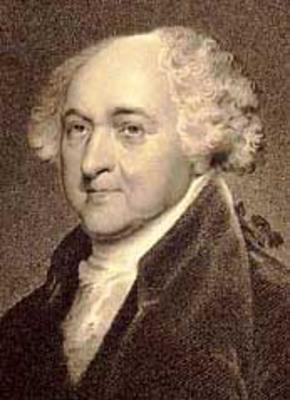
John Adams


I've been interested in history in all times.


Not until last week had I had the interview at a private school, the Lang. dept. Chair told me to be prepared that the school might want the Chinese teacher to teach one Chinese History class outside the regular language classes (IF, there aren't enough enrollment...). I remembered I used to think that if I didn't teach the language subject, I'd like to teach history instead.

History, i.e. his+story, apparently it's a genre about all kinds stories. Who wouldn't love stories? That's also the reason why I like watching movies, I guess, to see how the director tell a story.

Anyways, after Elizabeth I and II, almost all Jane Austen's adopted movies & TV series, I really enjoy watching HBO's John Adams for the past 2 weeks. It was only 5 years ago that I took the American History class during my 1st semester at SFSU. I could never remember the original 13 states at that time. However, after the 1st 2 episodes on HBO, those 13 states are easier to memorize now.

One interesting thing I observed in "John Adams" and it's also related to my profession is, when Johan Adams was assigned to gain the $$ and alliance with France in 1776, even as such a eloquent lawyer like John Adams himself failed to accomplish his mission due to the cultural difference and language barrier (Yeah... when the French king Louis XVI made fun of him:" No French? Not even one word?!" That really humiliated Adams).

Thank goodness, Adams' very political accurate wife Abigail asked him to bring their eldest son, John Quincy Adams (later he was elected as the 6th U.S. president in 1825 ), with him during this long trip. Little John Quincy went to school in Paris probably from ages 10~14, then at the age of 14, he travelled to St. Petersburg, Russia under his father's will to serve as translator and interpreter to the newly appointed American minster
because the new U.S. diplomat needs a secretary who speaks French to help him survive in Queen Catherine's French-speaking court.

When I was watching this segment of the episode, I couldn't help but wondering what Mindy said in the comment about why most American are monolingual... So, we might see what things were like 230 years ago in the colonial America era. Sure, we can always debate that there might not be any resources for ordinary people to acquire a foreign language when they were struggling from day-to-day life. But, what about now?
Even now, most Americans still don't value the importance of acquiring foreign language(s). Of course the Bush Administration has stressed the need to have more Americans master “critical” languages, including Arabic, Chinese, Russian, Hindi and Farsi. Officials, noting that fewer than 2 percent of American students currently study any of the target languages, said that they are critical to national security and cultural understanding. However, from my previous interview experiences with one language school and 4 private schools in L.A. area, either none of the school directors have ideas of how the Chinese program will thrive (or we should say "survive" here, if they can't get enough students to enroll in the class, or drop out afterwards) or they don't know what to expect and achieve in this new Mandarin Chinese learning trend... There are still a lot of seeding and plowing to do in this newly developed ground.

Being able to speak French might not be the sole reason that John Quincy Adams later became the 6th U.S. president, but it was definitely the main reason why he was chosen to be the secretary at the age of 14. I believe that knowing a foreign language won't necessary bring you any immediate benefit, but surely will broaden your horizon of the world. And when the opportunity knocks on your door, you'll be more ready than others who don't posses this ability.

Monday, March 17, 2008

CarneySandoe SF Forum

"...Was it a waste of time?..."

My mom-in-law left a voice message in my cell asking me about the past event in San Francisco last weekend while she was tyring to set a date to meet us in L.A.. Later I told her, I didn't regret to spend about $600, 700 dollars (incl. 2 nights @hotel, flight tickets, public transits and basic meals) flying up to SF for that California private school job searching conference, and ended up having 2 interviews only. One school was the 2nd interview actually, another girl school I kinda like is located in Pasadena though (about 1 hr drive from my place, which means at least 2-hour commute every day... No way...).

But, it's always good to visit San Francisco. Even though it was still freezing cold (about 40~50 F/10~15C), I managed to get a massage in Chinatown, checked a few stores I've always liked, dined at "King of Thai" twice, "The Scala" French bistro for 1st day breakfast, "La French Press" for breakfast the 2nd morning, and "Boudin" for sourdough bread lunch.

Overall, it's a nice trip. But it's more like a little vocation to myself. As my step-father-in-law said: "Honey, you're entitled to it. No worries."

A few interesting observations during the forum:

  1. The overall candidates are younger, and well-dressed.

Maybe it's a private school thing, or because you don't need a CA teaching credential for this, most candidates are like in their early or mid 20-something. And they sure know how to dress for success. I was a bit embarrassed by my very teacher-like outfit (black cashmere cardigan+coral shirt and gray trousers+silver flats). After living in the U.S. for 5 years, and seeing how those ESL teachers dressed up, I've been very sloppy for my personal image than I used to be. And I don't know why, I just can't dress up like a "corporate" anymore. Those tailored suit (blazer and skirt), 3-inch high heels are very far away from me now. I might just donate my 1 or 2 suits to dressforsuccess.org.

2. The myth of "Chinese" teacher.

The forum is in a pretty formal setting like 50 schools tried to interview all 50-200 candidates within 8 hours. So, it's sort like speed dating, everyone gets about 20-25 mins to talk to each other and find out if they're a good fit (of course, you have to make a request to the school you're interested in first, the school can either reject, ignore or accept you, and vice versa).

At one point, I was just waiting, and reading a book outside the conference hall with a bunch of other female candidates. Then we started to chat and found out we are all language teachers at the same table. The French teacher said something to catch my attention: ".... I was laid off because the school wanted to start a new Chinese program... but later I found out that new Chinese program was discontinued because there weren't enough students enrolled in the class."

Then a Spanish teacher complained about one of her previous interview experiences:"... I was talking to that director in Spanish during the whole interview. But at the end of it, she questioned me that she's afraid my Spanish is not good enough compared to the native Spanish speakers...".

An English teacher, who looks pretty young, and recently just received her master degree said: "No school is hiring English teacher now... I heard they just want Chinese teachers...". (My O.S.: Hello? Just want Chinese teachers? That's weird... I'm here! How come I requested interviews to 7 schools in L.A. area, got 2 rejections, 1 acceptance, 4 unheard...)? She continued:" I just did an interview with a Singapore high schools, they want me so bad. I could literally just accept that job on the spot... Maybe I should really think about it... I heard they have developed the whole system of 'Singlish' now...".

And of course, we together started to attack how bad the American education system has become these days... How public school system is even worse, and the teacher was tormented by the Bush administration's "No Child Left Behind" policy.

Hmm... Anyway, that's why I worry so much about the future of America. Sure I'm not a citizen yet, but my husband is, and our future kids will be. I certainly don't want to send my kids to a pricy private school so he or she can get a better education. All I can do now is to devote myself to a very tiny part of this system, try my best to make some differences, and hope a better future for everyone here.